Contact us
Discover how Quindi can improve your production


The plant operates at full capacity while maintaining its target of 500 bicycles per day, even with different orders, greater product variety, and increasing customization requirements.
ERP, WMS, assembly data, and production information converge into a single interconnected operational flow, readable and updated in real time.
Every bicycle, phase, and workstation leaves a readable trace: progress, timing, activities, and issues become useful data to control and improve production.

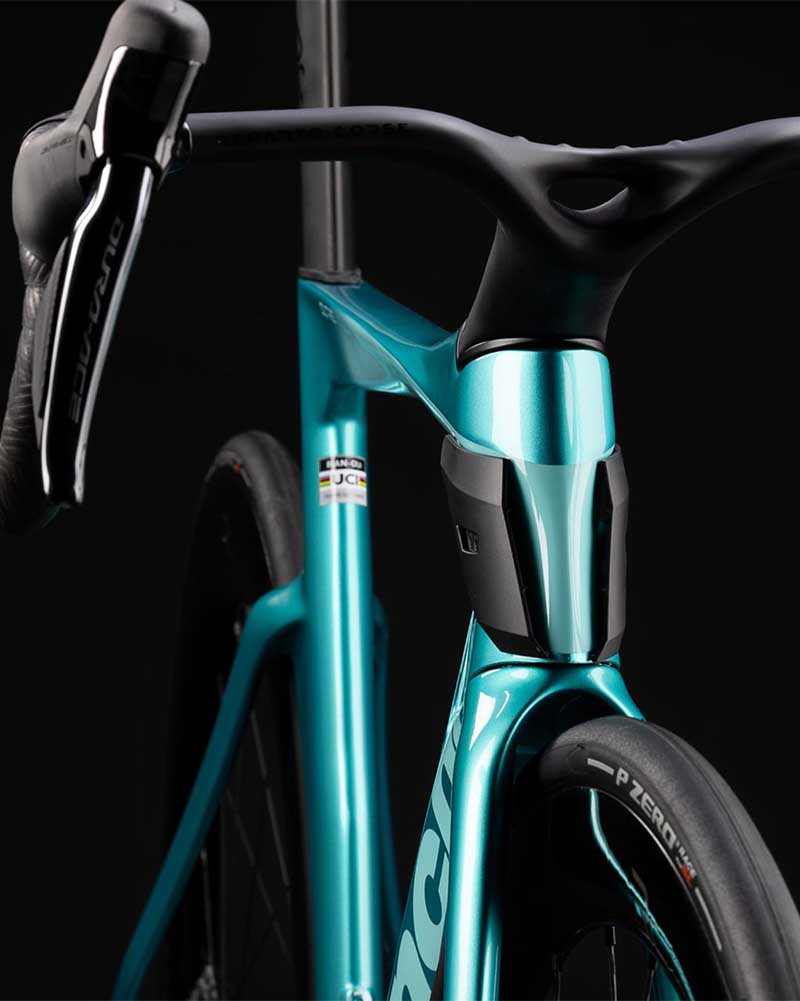
For more than 130 years, Bianchi has been part of bicycle history, with an international presence across racing and everyday bikes. In 2020, the company launched a new production plant with a clear objective: bring industrial capacity closer to the heart of the brand and bring the plant up to full operating speed. The challenge came from a production environment that was becoming more demanding by the day: greater product variety, smaller batches, increasing customization, and a target of up to 500 bicycles per day. Producing more was no longer the whole point. Bianchi needed a plant able to stay fluid and resilient, even as every order became less standard than the previous one.

500 bicycles per day,
with growing variety.



From live data to operational decisions.


Quindi connects automated assembly, ERP, WMS, RFID, and production data into a single operating system. Orders, materials, workstations, and progress no longer remain separate pieces of information: they feed the same live data foundation.

Each frame is associated with a production order and becomes a unique production unit. RFID tracks its movement in and out of workstations, making progress visible without manual data entry.

Quindi supports order planning, line balancing, and workforce management. Its AI helps interpret constraints, priorities, and operational capacity, making the production flow more continuous and controlled.

Quindi makes data, KPIs, and process information available when they are needed: at the workstation, through dedicated interfaces, or even on mobile. The goal is not to review reports after the fact, but to understand what is happening while the process can still be changed.
Quindi connects automated assembly, ERP, WMS, RFID, and production data into a single operating system. Orders, materials, workstations, and progress no longer remain separate pieces of information: they feed the same live data foundation.
Each frame is associated with a production order and becomes a unique production unit. RFID tracks its movement in and out of workstations, making progress visible without manual data entry.
Quindi supports order planning, line balancing, and workforce management. Its AI helps interpret constraints, priorities, and operational capacity, making the production flow more continuous and controlled.
Quindi makes data, KPIs, and process information available when they are needed: at the workstation, through dedicated interfaces, or even on mobile. The goal is not to review reports after the fact, but to understand what is happening while the process can still be changed.

Return on AI,
produced on the shop floor
Production target reached and maintained, even with greater product variety, smaller batches, and increasing customization.
Machine states are monitored across working time, setup, idle time, errors, and micro-stops.
Traceable control across kitting, components, and configuration reduces the risk of errors before production of each individual unit begins.
Process deviations are detected as they happen, with data and analytics that help read anomalies, recurring issues, and operational patterns.
Each frame becomes a unique production unit: order, workstation, components, and progress remain connected to the individual piece.
Live data and AI analytics help managers understand production performance while it happens. KPIs, anomalies, delays, and critical signals become actionable information before they become operational costs.


